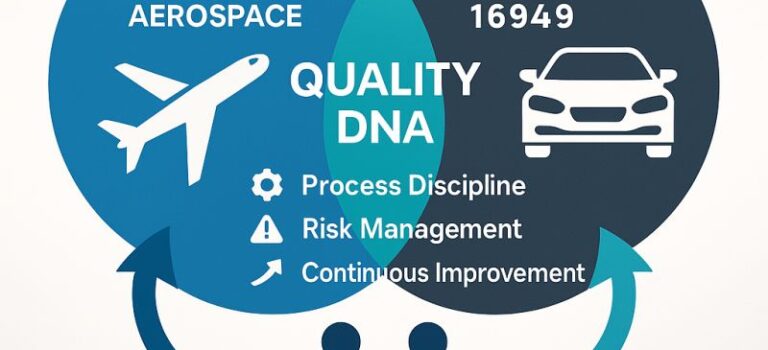
🔍 IATF 16949 vs. EN 9100: Same Foundation, Different Universe
Both standards are built on ISO 9001:2015. Both follow a plan-do-check-act structure with near-identical section numbering. That is where practical overlap ends.
In January 2025, IATF 16949 entered its most significant audit scheme revision in nearly a decade: Rules 6th Edition replaced employee-count-based audit days with a Risk-Based Audit Duration (RBAD) model and capped surveillance visits at 2 per 3-year certification cycle. Simultaneously, the IAQG is retiring the AS9100 designation entirely — the next version will be called IA9100, for International Aerospace — aligned to ISO 9001:2026, expected for publication in September 2026. Two parallel revision cycles. One ISO 9001 baseline forcing both frameworks forward at the same time.
For quality professionals operating across aviation and automotive, or advising DACH manufacturers whose suppliers hold one or both certifications, the differences are not theoretical. They are audit findings.
But let me be direct: treating IATF 16949 and EN 9100 as interchangeable credentials is a root cause, not a qualification. The risk tolerance, the required tools, the documentation depth, and the incoming requirements under IA9100 differ in ways that will show up on your next audit report.
1. The Philosophy Gap: Safety-Critical vs. Cost-Efficient Reliability
EN 9100 / AS9100D — and the incoming IA9100 — operates under a zero-defect-tolerance philosophy rooted in a hard engineering reality: a fastener on a commercial aircraft fuselage that fails at altitude is not a warranty claim. This shapes everything from how safety-critical characteristics are identified at design stage, to configuration management obligations, to traceability requirements that extend to raw material lot level. The standard expects organizations to demonstrate that failure modes have been considered and controlled before the first part ships, not after the first defect is reported.
IATF 16949 operates under a different constraint. Automotive production at volume — think a modern assembly line running 60 vehicles per hour — cannot carry the cost structure of aerospace traceability on every fastener. The standard instead prioritizes defect prevention at high throughput: statistical process control, error-proofing (Poka-Yoke), measurement system analysis calibrated to production process capability, and PPAP (Production Part Approval Process) that validates the production system against customer requirements before serial production launch. The question IATF 16949 asks is: can this process reliably produce conforming parts at rate? The question EN 9100 asks is: can this organization prove that every delivered part is what the design record says it is?
Neither framework is more rigorous than the other. They are calibrated to different risk profiles and different consequence scales. The confusion arises when organizations assume that holding one certification prepares them for the other.
2. The Technical Divergence: What Each Standard Mandates That the Other Does Not
Three EN 9100 / AS9100D requirements have no direct equivalent in IATF 16949:
Configuration management (AS9100D Section 8.1.2) requires documented configuration baselines, formal change control processes, and product traceability throughout the full lifecycle. This is not a generic document control requirement — it is a structured engineering discipline with defined records and a continuous audit trail from design release through end-of-life.
First Article Inspection (FAI) per AS9102 mandates a documented inspection against the full design record for every new or modified part. The FAI must address all drawing characteristics via a balloon drawing, with measured data, functional test results, and material certifications captured in a single package. IATF 16949 has PPAP — overlapping intent, different scope, different execution.
Key Characteristics (KCs) and safety-critical feature controls must be explicitly identified, linked to appropriate risk mitigation, and — under the incoming IA9100 — connected to the organization’s Safety Management System (SMS). An AS9100D auditor will ask to see how KCs are identified, controlled, and monitored in production. An IATF 16949 auditor will not.
Three IATF 16949 requirements with no direct equivalent in EN 9100:
Total Productive Maintenance (TPM) is a required system under IATF 16949 Section 8.5.1.5. Organizations must demonstrate documented OEE targets, planned maintenance intervals, and structured predictive maintenance programs. EN 9100 requires equipment control, but not at this level of operational discipline.
Production scheduling and capacity analysis (IATF 16949 Section 8.1.1) requires suppliers to demonstrate that schedules are achievable and that capacity constraints are actively managed. This requirement is driven by just-in-time automotive production realities — automotive OEMs expect their suppliers to know their own capacity limits before a line stop occurs.
AIAG Core Tools — APQP (Advanced Product Quality Planning), PPAP, FMEA (aligned to the AIAG-VDA FMEA Handbook, 1st Edition 2019), MSA (AIAG MSA Reference Manual, 4th Edition), and SPC — are referenced as required methodologies throughout IATF 16949, not optional references. An IATF 16949 auditor will ask to see your MSA study results and SPC control charts as a default. An EN 9100 auditor will not — unless your aerospace customer has flowed down AS9145 requirements via contract.
3. The 2026 Double Revision: ISO 9001:2026 Puts Both Frameworks in Motion Simultaneously
ISO 9001:2026 is expected for publication in September 2026. This triggers mandatory revision cycles for both sector standards.
For IATF 16949: The standard itself remains at the 2016 version until the next revision publishes, expected 12–18 months after ISO 9001:2026 — placing it in 2027 or early 2028. Rules 6th Edition already restructured the audit scheme: RBAD replaced the employee-count model on January 1, 2025. Surveillance audits are now capped at 2 visits per 3-year cycle with 12-monthly intervals required. The uniform 15% corporate audit day reduction replaced the previous 20–40% variable range. Certified organizations that have not reviewed their audit contracts against these rules are operating on an outdated basis.
For EN 9100 / IA9100: The IAQG is renaming the standard from AS9100 to IA9100 — International Aerospace — reflecting global coordination across the Americas, Europe, and Asia Pacific regions. IA9100 is expected in late 2026. The formal transition window is 2–3 years from publication, placing the compliance deadline between late 2028 and late 2029. The new requirements that do not exist in AS9100D include: mandatory cybersecurity programs integrated into the quality risk plan (organizations must evaluate cyber threats on ERP systems, remote access tools, and production data flows, and deploy documented access controls and recovery plans), ethics and quality culture requirements extending from top management to the shop floor, human factors analysis in nonconformance root cause investigations (fatigue, mental workload), and strengthened sub-tier supplier controls beyond Tier-1 relationships.
Organizations holding AS9100D / EN 9100:2018 certification today should not assume their current gap analysis will remain valid when the IA9100 final text publishes. The cybersecurity requirement alone requires process design, documented programs, and evidence of implementation — not a gap assessment performed two weeks before the transition audit.
3 Concrete Actions
1. Map your standard scope against your product families before your next internal audit. If you produce for both aviation and automotive customers, confirm that every procedure references the correct standard for that product line. A TPM program written to satisfy IATF 16949 Section 8.5.1.5 is not evidence for AS9100D Section 8.5.1 — the requirements diverge at the implementation level. Procedure scope confusion is a consistent source of major non-conformances on dual-certified sites.
2. For EN 9100 / AS9100D certified organizations: begin your IA9100 readiness assessment now, not when the standard publishes. The cybersecurity integration requirement and the human factors root cause analysis obligation are not minor document additions — they require new processes, trained personnel, and implementation evidence. Starting 18 months before the transition deadline is minimum lead time, not early action.
3. For IATF 16949 certified organizations: verify your audit contract and RBAD calculation with your certification body. If your current contract still specifies 6-monthly or 9-monthly surveillance intervals, it is non-compliant with the January 2025 Rules 6th Edition requirement for 12-monthly intervals. The shift from employee-count to risk-based audit days also changes the number of billable audit days — review the calculation before your next recertification cycle.
The Bigger Picture
ISO 9001:2026, the next IATF 16949 revision, and IA9100 are all arriving within the same 24-month window. This is not coincidence — it is the structural consequence of how sector standards are built. ISO 9001 is the foundation; IATF 16949 and EN 9100 extend it with industry-specific requirements. When the foundation revises, both sector standards must follow.
For organizations in aviation or automotive quality, 2026 and 2027 will be dominated by transition planning. The organizations that treat this as a documentation update will struggle in audit. The organizations that use the revision cycle to redesign their quality systems around the new requirements — particularly IA9100’s cybersecurity and sub-tier supplier control additions — will build measurably stronger frameworks.
26 years working across aviation, automotive, and regulated industries tells me the following: standards transitions are where the gap between organizations that understand their QMS and organizations that maintain their QMS becomes visible. The window to close that gap is open now. After the first IA9100 transition audits begin, it becomes remediation.
Request a Technical Consultation →
Sources
- IATF Global Oversight — IATF 16949 Rules 6th Edition
- Smithers — IATF 16949 Rules 6th Edition: Key Updates & Implications
- IAQG — 9100 Quality Management Systems Requirements
- QT9 Software — IA9100 is Coming: Key Updates for Aerospace & Defense
- CVG Strategy — IA9100 Series Standards Due for Release in 2026
- Quality Magazine — ISO 9001 in 2026: AS9100 (IA9100), IATF 16949, and How They Fit Together
- TÜV — Overview & Schedule: Revision of ISO 9001 coming in 2026
- AIAG — Quality Core Tools: APQP, PPAP, FMEA, MSA, SPC
- Advisera — IATF 16949 vs. AS9100D Comparison of Requirements
- Cavendish Scott — IA9100 is Coming: What the 2026 Updates Mean for Aerospace Quality
Hashtags
#AviationQuality #IATF16949 #EN9100 #AS9100 #IA9100 #QualityManagement #SupplierQuality #ISO9001 #AerospaceQuality #AutomotiveQuality #IAQG #AIAG #QMS #SecondPartyAudit #SKQC