IATF 16949 vs. EN 9100: Same Foundation, Different Universe

IATF 16949 vs. EN 9100: Same Foundation, Different Universe

🔍 IATF 16949 vs. EN 9100: Same Foundation, Different Universe

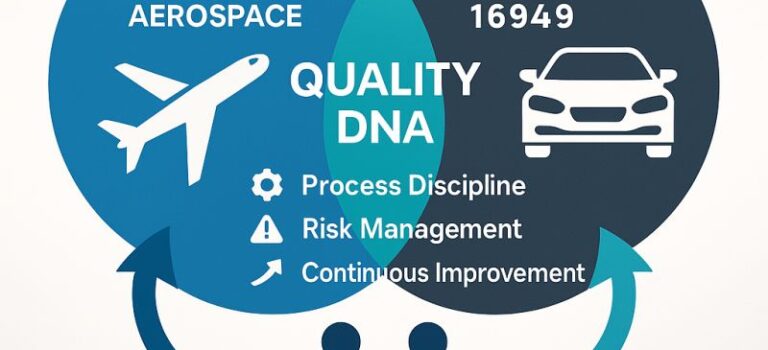
Both standards are built on ISO 9001:2015. Both follow a plan-do-check-act structure with near-identical section numbering. That is where practical overlap ends.

In January 2025, IATF 16949 entered its most significant audit scheme revision in nearly a decade: Rules 6th Edition replaced employee-count-based audit days with a Risk-Based Audit Duration (RBAD) model and capped surveillance visits at 2 per 3-year certification cycle. Simultaneously, the IAQG is retiring the AS9100 designation entirely — the next version will be called IA9100, for International Aerospace — aligned to ISO 9001:2026, expected for publication in September 2026. Two parallel revision cycles. One ISO 9001 baseline forcing both frameworks forward at the same time.

For quality professionals operating across aviation and automotive, or advising DACH manufacturers whose suppliers hold one or both certifications, the differences are not theoretical. They are audit findings.

But let me be direct: treating IATF 16949 and EN 9100 as interchangeable credentials is a root cause, not a qualification. The risk tolerance, the required tools, the documentation depth, and the incoming requirements under IA9100 differ in ways that will show up on your next audit report.


1. The Philosophy Gap: Safety-Critical vs. Cost-Efficient Reliability

EN 9100 / AS9100D — and the incoming IA9100 — operates under a zero-defect-tolerance philosophy rooted in a hard engineering reality: a fastener on a commercial aircraft fuselage that fails at altitude is not a warranty claim. This shapes everything from how safety-critical characteristics are identified at design stage, to configuration management obligations, to traceability requirements that extend to raw material lot level. The standard expects organizations to demonstrate that failure modes have been considered and controlled before the first part ships, not after the first defect is reported.

IATF 16949 operates under a different constraint. Automotive production at volume — think a modern assembly line running 60 vehicles per hour — cannot carry the cost structure of aerospace traceability on every fastener. The standard instead prioritizes defect prevention at high throughput: statistical process control, error-proofing (Poka-Yoke), measurement system analysis calibrated to production process capability, and PPAP (Production Part Approval Process) that validates the production system against customer requirements before serial production launch. The question IATF 16949 asks is: can this process reliably produce conforming parts at rate? The question EN 9100 asks is: can this organization prove that every delivered part is what the design record says it is?

Neither framework is more rigorous than the other. They are calibrated to different risk profiles and different consequence scales. The confusion arises when organizations assume that holding one certification prepares them for the other.


2. The Technical Divergence: What Each Standard Mandates That the Other Does Not

Three EN 9100 / AS9100D requirements have no direct equivalent in IATF 16949:

Configuration management (AS9100D Section 8.1.2) requires documented configuration baselines, formal change control processes, and product traceability throughout the full lifecycle. This is not a generic document control requirement — it is a structured engineering discipline with defined records and a continuous audit trail from design release through end-of-life.

First Article Inspection (FAI) per AS9102 mandates a documented inspection against the full design record for every new or modified part. The FAI must address all drawing characteristics via a balloon drawing, with measured data, functional test results, and material certifications captured in a single package. IATF 16949 has PPAP — overlapping intent, different scope, different execution.

Key Characteristics (KCs) and safety-critical feature controls must be explicitly identified, linked to appropriate risk mitigation, and — under the incoming IA9100 — connected to the organization’s Safety Management System (SMS). An AS9100D auditor will ask to see how KCs are identified, controlled, and monitored in production. An IATF 16949 auditor will not.

Three IATF 16949 requirements with no direct equivalent in EN 9100:

Total Productive Maintenance (TPM) is a required system under IATF 16949 Section 8.5.1.5. Organizations must demonstrate documented OEE targets, planned maintenance intervals, and structured predictive maintenance programs. EN 9100 requires equipment control, but not at this level of operational discipline.

Production scheduling and capacity analysis (IATF 16949 Section 8.1.1) requires suppliers to demonstrate that schedules are achievable and that capacity constraints are actively managed. This requirement is driven by just-in-time automotive production realities — automotive OEMs expect their suppliers to know their own capacity limits before a line stop occurs.

AIAG Core Tools — APQP (Advanced Product Quality Planning), PPAP, FMEA (aligned to the AIAG-VDA FMEA Handbook, 1st Edition 2019), MSA (AIAG MSA Reference Manual, 4th Edition), and SPC — are referenced as required methodologies throughout IATF 16949, not optional references. An IATF 16949 auditor will ask to see your MSA study results and SPC control charts as a default. An EN 9100 auditor will not — unless your aerospace customer has flowed down AS9145 requirements via contract.


3. The 2026 Double Revision: ISO 9001:2026 Puts Both Frameworks in Motion Simultaneously

ISO 9001:2026 is expected for publication in September 2026. This triggers mandatory revision cycles for both sector standards.

For IATF 16949: The standard itself remains at the 2016 version until the next revision publishes, expected 12–18 months after ISO 9001:2026 — placing it in 2027 or early 2028. Rules 6th Edition already restructured the audit scheme: RBAD replaced the employee-count model on January 1, 2025. Surveillance audits are now capped at 2 visits per 3-year cycle with 12-monthly intervals required. The uniform 15% corporate audit day reduction replaced the previous 20–40% variable range. Certified organizations that have not reviewed their audit contracts against these rules are operating on an outdated basis.

For EN 9100 / IA9100: The IAQG is renaming the standard from AS9100 to IA9100 — International Aerospace — reflecting global coordination across the Americas, Europe, and Asia Pacific regions. IA9100 is expected in late 2026. The formal transition window is 2–3 years from publication, placing the compliance deadline between late 2028 and late 2029. The new requirements that do not exist in AS9100D include: mandatory cybersecurity programs integrated into the quality risk plan (organizations must evaluate cyber threats on ERP systems, remote access tools, and production data flows, and deploy documented access controls and recovery plans), ethics and quality culture requirements extending from top management to the shop floor, human factors analysis in nonconformance root cause investigations (fatigue, mental workload), and strengthened sub-tier supplier controls beyond Tier-1 relationships.

Organizations holding AS9100D / EN 9100:2018 certification today should not assume their current gap analysis will remain valid when the IA9100 final text publishes. The cybersecurity requirement alone requires process design, documented programs, and evidence of implementation — not a gap assessment performed two weeks before the transition audit.


3 Concrete Actions

1. Map your standard scope against your product families before your next internal audit. If you produce for both aviation and automotive customers, confirm that every procedure references the correct standard for that product line. A TPM program written to satisfy IATF 16949 Section 8.5.1.5 is not evidence for AS9100D Section 8.5.1 — the requirements diverge at the implementation level. Procedure scope confusion is a consistent source of major non-conformances on dual-certified sites.

2. For EN 9100 / AS9100D certified organizations: begin your IA9100 readiness assessment now, not when the standard publishes. The cybersecurity integration requirement and the human factors root cause analysis obligation are not minor document additions — they require new processes, trained personnel, and implementation evidence. Starting 18 months before the transition deadline is minimum lead time, not early action.

3. For IATF 16949 certified organizations: verify your audit contract and RBAD calculation with your certification body. If your current contract still specifies 6-monthly or 9-monthly surveillance intervals, it is non-compliant with the January 2025 Rules 6th Edition requirement for 12-monthly intervals. The shift from employee-count to risk-based audit days also changes the number of billable audit days — review the calculation before your next recertification cycle.


The Bigger Picture

ISO 9001:2026, the next IATF 16949 revision, and IA9100 are all arriving within the same 24-month window. This is not coincidence — it is the structural consequence of how sector standards are built. ISO 9001 is the foundation; IATF 16949 and EN 9100 extend it with industry-specific requirements. When the foundation revises, both sector standards must follow.

For organizations in aviation or automotive quality, 2026 and 2027 will be dominated by transition planning. The organizations that treat this as a documentation update will struggle in audit. The organizations that use the revision cycle to redesign their quality systems around the new requirements — particularly IA9100’s cybersecurity and sub-tier supplier control additions — will build measurably stronger frameworks.

26 years working across aviation, automotive, and regulated industries tells me the following: standards transitions are where the gap between organizations that understand their QMS and organizations that maintain their QMS becomes visible. The window to close that gap is open now. After the first IA9100 transition audits begin, it becomes remediation.

Request a Technical Consultation →


Sources


Hashtags

#AviationQuality #IATF16949 #EN9100 #AS9100 #IA9100 #QualityManagement #SupplierQuality #ISO9001 #AerospaceQuality #AutomotiveQuality #IAQG #AIAG #QMS #SecondPartyAudit #SKQC



Raw Material Prices in 2026: What Geopolitical Shifts Mean for Your Supplier Quality

Titanium sponge in the USA reached USD 3,081 per metric ton in June 2025 — compared to USD 1,590/MT in China during the same period. That price gap is not a market anomaly. It is the measurable cost of geopolitical decoupling, and it is now embedded in the cost structure of every Western aerospace supplier who cannot source from Russia or China. For quality managers, the material price is the headline. The risk underneath it is what matters.

Three raw material stories are running simultaneously in 2026. Each one is creating a different set of quality risks in the supplier base. None of them will show up in a standard supplier scorecard.

1. Titanium: The Decoupling That Cannot Be Reversed Quickly

VSMPO-AVISMA — Russia’s integrated titanium producer — historically supplied 25-30% of the global aerospace-grade titanium market. Boeing halted Russian imports in March 2022. Airbus followed, more slowly. Ukraine’s Zaporizhzhia Titanium-Magnesium Plant, which previously supplied feedstock to Russian smelters, has been out of operation since the invasion with no clear reopening timeline.

The structural consequence: new aerospace-grade titanium qualification from alternative sources — Japan, Kazakhstan, the U.S. — requires multi-year certification cycles under FAA, EASA, and OEM material standards. ATI Inc. opened a new titanium alloy sheet production facility in Pageland, South Carolina in June 2025. It is a meaningful investment. It is not a 2026 solution at scale. As Nils Backeberg from Project Blue stated: „US sponge production revival and increasing the scale of Indian production are strategic, long-term options, not 2026 solutions.“

For quality managers, the titanium situation creates three specific risks that a standard audit does not address:

Unauthorized material substitution under cost pressure. When aerospace-grade titanium from qualified sources is constrained and expensive, suppliers face margin pressure that can lead to substitution with nominally equivalent but uncertified alternatives. In aerospace, this is a direct airworthiness risk. The substitution frequently goes undocumented and undetected until a deviation surfaces in production or in the field. An FAI or PPAP completed with one material source does not cover a subsequent substitution, regardless of nominal material equivalency.

Sub-tier sourcing changes that bypass your approved supplier list. Your Tier-1 supplier may have qualified sources. Their Tier-2 material supplier may not. Geopolitical disruptions force mid-tier sourcing decisions that are made quickly, often without formal change notification. The approved supplier list you audited against six months ago may not reflect current sourcing reality.

Lead time extension creating schedule pressure that erodes process margins. Longer lead times from qualified titanium sources mean suppliers are building with tighter inventory buffers. Schedule pressure consistently correlates with reduced inspection frequency, deferred maintenance on critical equipment, and operator decisions that fall outside the process window defined in the approved quality plan.

2. Rare Earths: China’s Export Controls Are a Quality System Event

On April 4, 2025, China’s Ministry of Commerce introduced export licensing requirements for seven medium and heavy rare earth elements: samarium, gadolinium, terbium, dysprosium, lutetium, scandium, and yttrium. China controls approximately 85-90% of global rare earth refining capacity and more than 90% of high-performance permanent magnet production.

The quality implications are already visible in production. Yttrium — essential for aeroengine thermal barrier coatings — saw exports from China to the United States collapse from 333 tons in the eight months before April 2025 to 17 tons in the eight months after. Aviation Week reported in April 2026 that U.S. avionics, actuator, and aeroengine manufacturers are experiencing procurement delays, longer lead times, higher costs, and growing schedule risk in both new production and aftermarket spares.

The October 2025 escalation went further: China introduced extraterritorial controls requiring export licenses for foreign-made products containing 0.1% or more of Chinese-origin rare earths. This applies globally. Any European aerospace supplier whose process uses Chinese-origin rare earth inputs, at any tier of the value chain, is now subject to Chinese licensing requirements.

Three concrete checks worth making in your next supplier audit:

First, ask your suppliers to identify which of their process inputs contain rare earth elements and whether those elements are sourced from Chinese-controlled supply chains. The answer „we don’t know“ is itself an audit finding.

Second, verify whether your suppliers have reviewed their change notification obligations in light of potential sourcing shifts. If a rare earth material shortage forces a process change, that is a formal customer notification requirement under EN 9100 Section 8.1.2 and IATF 16949 Section 8.3.6.

Third, assess whether force majeure clauses in your supplier contracts actually cover government-imposed export restrictions. Legal advisors across Europe noted in 2025 that this coverage cannot be assumed.

3. Carbon Fiber: Price Stability Masking Process Instability

Carbon fiber prices in Germany reached EUR 33.8/kg in December 2025. The stability is regional. For aerospace and automotive composite suppliers, the real issue is the material qualification regime. Aerospace-grade carbon fiber requires OEM-qualified material specifications that cannot be transferred between suppliers without requalification taking 12-24 months. Suppliers under cost pressure may rationalize that „equivalent“ material is acceptable without understanding that equivalency in aerospace is defined by the approved materials list, not by specification similarity.

What This Means for Your Audit Programme

Risk-based audit planning in 2026 needs to explicitly address material sourcing stability. For each critical supplier, the questions worth adding to your audit agenda: Has the supplier experienced any raw material sourcing changes in the past 12 months that were not formally notified? Has the supplier assessed their exposure to geopolitical supply risks and incorporated that into their risk register? Does the emergency response plan address material substitution scenarios with a customer notification requirement before any unapproved substitution occurs?

3 Concrete Actions

1. Add a raw material sourcing review to your next supplier audit for any supplier working with titanium, rare earth-containing materials, or aerospace-grade composites. Request documentation of current approved sources, evidence of any sourcing changes in the past 12 months, and their sub-tier visibility process. An undocumented sourcing change at Tier-2 level is a Tier-1 quality system finding.

2. Review your supplier change notification requirements and verify that they explicitly cover material sourcing changes — not just process or design changes. Many quality agreements were written before geopolitical raw material risk was a routine operational concern.

3. For organizations with European suppliers using rare earth-containing materials: initiate a conversation about exposure to Chinese export licensing requirements under the April 2025 and October 2025 MOFCOM controls. CSIS analysts noted explicitly that China has demonstrated it is not a reliable export partner during periods of geopolitical tension.

👉 Request a Technical Consultation → www.skqc.org

Sources

  • IMARC Group — Titanium Price Trend, Index and Forecast 2025: USD 3,081/MT USA
  • AeroTime — Global titanium supply squeeze: Who controls the market? (October 2025)
  • CSIS — Rare Earth Export Restrictions One Year Later (May 2026)
  • Aviation Week — China’s Rare Earth Leverage Is Aerospace’s Latest Constraint (April 2026)
  • Mayer Brown — PRC Announces New Export Controls on Rare Earth and Battery Materials (October 2025)
  • IMARC Group — Carbon Fibre Price Trend, Index, Chart 2026

#SupplierQuality #RawMaterials #GeopoliticalRisk #QualityManagement #AerospaceQuality #TitaniumSupply #RareEarths #SKQC

independent quality consultant aviation audit documentation whistleblower

„What a Whistleblower Case in Aviation Taught Me About the Value of Independence“


🔍 Sometimes the Most Important Quality Tool Is Someone Who Has Nothing to Lose by Telling the Truth.

In my 26 years in aviation and automotive quality management, some of the most consequential work I have done has not been in audit rooms or supplier development meetings. It has been in situations where an organization needed someone with technical authority, no internal political stake, and the professional backing to document what others already knew but could not formally say.

Whistleblower situations in aviation are more common than the industry publicly acknowledges. They arise when a supplier documents a non-conformance that an OEM does not want to accept. They arise when a process deviation is known internally but not reported because of schedule pressure. They arise when an incoming inspection finding is overridden without proper engineering disposition — and someone in the organization recognizes that the decision creates airworthiness risk.

In these situations, an independent quality consultant with no employment relationship to either party is not just useful. In some cases, they are the only professional who can document the situation with the technical credibility and legal independence that the circumstances require.

I have supported organizations in exactly these situations — in aviation, in automotive, and in renewable energy. My role has included technical documentation of non-conformances, independent audit findings, regulatory reporting support, and bridging the communication gap between a European parent organization and a U.S.-based operation where the concern originated.

This is not a common service offering. It requires:

→ Deep technical knowledge of the relevant quality standards (EN9100, IATF 16949, EASA Part-21/145) → Professional independence — no ongoing commercial relationship with the organization under review → The ability to document findings in a format that is legally defensible and regulatorily actionable → Cross-cultural competency — particularly when a European organization is trying to understand and respond to a situation at a U.S. facility

If your organization is facing a situation where internal quality processes have not produced a resolution — or where the stakes are high enough that an independent technical assessment is needed — I am available for that work.

📌 Independent quality assessment and whistleblower support — confidential, technically grounded, professionally documented. 👉 Contact Sascha Kauderer → skqc.org

: ILA Berlin Farnborough 2026 aerospace quality supplier readiness airshow

ILA Berlin 2026 Recap & Farnborough Preview: What Two Major Airshows Reveal About the State of Aerospace Quality

ILA Berlin 2026 closed its trade visitor days on June 12. The numbers are substantial: more than 600 exhibitors from over 35 countries, 200+ delegations, and 350 speakers across three stages made it the most internationally attended ILA in years. The Supplier Centre ran at full capacity across the three trade days. eVTOL and Advanced Air Mobility featured prominently across multiple exhibition segments.

Now the industry’s attention turns to Farnborough. The Farnborough International Airshow 2026 takes place July 20–24 in Hampshire, UK — and at over 12,000 expected trade visitors, it remains one of the most commercially significant aerospace events on the calendar.

What ILA Berlin 2026 Actually Revealed

Theme 1: Production Rate Pressure Is the Dominant Quality Risk

Every conversation in the Supplier Centre this year came back to the same operational reality: OEMs need more output, faster, without compromising conformance. Airbus’s A320neo family production target of 75 aircraft per month by 2026 — up from approximately 50 per month in 2023 — requires a proportional increase in Tier-1 and Tier-2 capacity.

The suppliers who managed this transition successfully at ILA were those who came with data — specifically, process capability data demonstrating that their critical characteristics remain stable at higher production rates. Those without this data were in a reactive position.

Theme 2: eVTOL Qualification Is Earlier Than Most Suppliers Think

The Advanced Air Mobility segment at ILA generated significant visibility. Several eVTOL developers have now moved from demonstrator programs into type certification activities under EASA’s SC-VTOL framework. Supplier qualification cycles for production-intent parts are beginning now — not in 2028 or 2030.

Suppliers who assumed they had two to three years to prepare their quality systems for eVTOL qualification requirements may need to reassess that timeline. The first SC-VTOL type certificates are expected in the 2027-2028 window.

Theme 3: Sustainability Documentation Is Becoming a Supplier Requirement

Multiple OEM representatives at ILA indicated that Environmental Product Declarations (EPDs) and lifecycle carbon data for purchased components are moving from voluntary reporting to contract requirements. For suppliers, this means quality management systems will need to incorporate environmental data traceability alongside dimensional and materials conformance documentation.

What to Watch at Farnborough 2026

Three specific areas deserve attention at Farnborough 2026:

First — composite structure programs. Both Airbus and Boeing have significant composite content in current and next-generation aircraft. Any new aircraft program announced with high composite content will immediately create qualification demand in the CFRP supplier base.

Second — engine supplier commitments. CFM International, Pratt & Whitney, and Rolls-Royce all have significant delivery backlogs. New commitments at Farnborough add to that backlog.

Third — emerging market airline orders. Airlines from Latin America, Southeast Asia, and the Middle East are expected to be active at Farnborough, creating MRO demand in markets where quality oversight infrastructure is still developing.

3 Concrete Actions Between ILA and Farnborough

→ If you supply composite structures or CFRP components, initiate a production capability review now.

→ Review your EPD and lifecycle carbon documentation capability. If OEM sustainability reporting requirements are moving toward contract terms, your quality system needs to be able to generate this data reliably.

→ Monitor Farnborough order announcements for program implications. Use the order data as a strategic planning input for your own capacity and quality development roadmap.

The Bigger Picture

ILA Berlin and Farnborough together represent the two most commercially significant aerospace events of 2026. The quality management challenge for the supplier base is to be positioned — in terms of process capability, certification readiness, and documentation maturity — to serve those programs when the production demand arrives.

The time to prepare for Farnborough’s commitments is before the ink dries on the order agreements. Not after.

📌 Is your quality and certification framework aligned with the production demands that the 2026 airshow season is generating?

Request a Technical Consultation → www.skqc.org

#ILABerlin2026 #Farnborough2026 #AerospaceQuality #SupplierReadiness #CFRP #eVTOL #ProductionRate #EN9100 #SKQC

Sources

ILA Berlin 2026: https://www.ila-berlin.de/en

Farnborough International Airshow 2026: https://www.farnboroughairshow.com

www.easa.europa.eu/en/domains/civil-drones/regulationsEASA SC-VTOL: https://www.easa.europa.eu/en/domains/civil-drones/regulations

ILA Berlin 2026: The Supplier Hall Is Where Quality Decisions Are Made — Not on the Flight Line

From June 10 to 14, 2026, the global aerospace industry converges at Berlin ExpoCenter Airport for ILA Berlin — Europe’s most significant aerospace trade fair. The numbers for 2026 are substantial: more than 600 exhibitors from over 35 countries, 200+ official delegations, 350 speakers across three stages, more than 100 aircraft in static and flying display, and over 100,000 expected trade and public visitors.

The flying displays will be spectacular. The OEM announcements will dominate the press coverage. But from a Quality Management perspective, the most strategically important part of ILA Berlin 2026 is one that rarely makes headlines: the International Supplier Centre.

This is where the actual quality decisions that determine the structural integrity of aircraft programs are negotiated, reviewed, and committed to.


What the ILA Supplier Centre Actually Represents

ILA Berlin’s International Supplier Centre brings together Tier-1 and Tier-2 suppliers with OEM procurement and engineering representatives in a structured B2B environment. For aerospace suppliers, this is not a trade fair booth exercise. It is a compressed evaluation cycle in which three to five years of relationship-building, qualification activity, and quality performance history is assessed in a matter of days.

The dynamics at the Supplier Centre reflect a structural reality in aerospace manufacturing: OEMs are not primarily looking for new suppliers at ILA. They are evaluating whether their existing suppliers can scale, remain compliant, and absorb the production rate increases that the current aircraft delivery backlog demands.

That context matters. Airbus has a backlog of over 8,700 aircraft as of early 2026. Boeing is working through its own delivery challenges following the regulatory scrutiny of 2024 and 2025. Both programs require Tier-1 suppliers to increase output while maintaining conformance quality — a combination that is structurally difficult and historically where non-conformance rates rise.


Three Quality Questions Every Supplier Should Be Able to Answer at ILA

Whether you are attending ILA Berlin 2026 or monitoring it from a distance, these are the three questions that define supplier quality credibility in the current aerospace environment:

1. What is your First Article Inspection (FAI) completion rate for new part numbers introduced in the last 18 months?

AS9102 First Article Inspection is the baseline conformance gate for new part introduction in aerospace. In periods of rapid production ramp-up, FAI completion rates are frequently the first quality metric to degrade. OEMs know this and increasingly use FAI completion data as a leading indicator of supplier readiness. If your FAI backlog has grown in the last two quarters, that is a signal — and it will be visible in the next audit.

2. How many of your current non-conformances have been open for more than 30 days?

Corrective action cycle time is the single most reliable indicator of quality system health in an operational environment. A supplier with a strong QMS closes non-conformances within defined timescales because root cause analysis and corrective action planning are embedded in the daily workflow — not treated as administrative tasks. If the average age of your open NCRs is trending upward, your quality system is losing ground, regardless of what your certification certificate says.

3. Can you demonstrate process capability (Cpk) data for your critical characteristics?

In the current environment, OEM expectations have shifted from attribute-based quality evidence to variable data. Demonstrating Cpk ≥ 1.33 for critical characteristics is increasingly a pre-condition for production approval — not a post-qualification exercise. Suppliers who cannot produce current, program-specific process capability data at a customer meeting are already behind the qualification threshold.


What ILA 2026 Signals for Supplier Quality Development

ILA Berlin 2026 has explicitly included Advanced Air Mobility and eVTOL in its sector coverage for the first time at this scale. This is industrially significant for quality management professionals because it signals the beginning of a supplier qualification cycle for a completely new class of aircraft — one that will require adaptation of existing aerospace quality standards to new propulsion concepts, new material combinations, and new operational profiles.

The EASA certification framework for eVTOL (Special Condition VTOL, SC-VTOL) is still being actively developed. Suppliers who begin positioning their quality systems for SC-VTOL requirements now — rather than waiting for the first contract — will have a structural advantage in the qualification cycle that follows.

This is the pattern that repeats in every new aerospace program generation: the suppliers who shape the quality requirements during development are the ones who dominate the production phase.


3 Concrete Actions — Whether You Are at ILA or Not

→ Request your OEM contact’s Approved Vendor List (AVL) status review before the trade fair season. ILA is a natural checkpoint for supplier relationship reviews. Use it proactively — do not wait to be called.

→ Prepare a one-page Quality Performance Summary. Cpk data for critical characteristics, FAI completion rate, NCR cycle time, and audit finding trend for the last four quarters. This is the data that matters in a 30-minute supplier meeting at ILA. If you cannot produce it in one page, your quality reporting structure needs review.

→ Map your quality system against SC-VTOL requirements. Even if eVTOL is not your current program scope, understanding where your existing EN9100 framework aligns — and where it does not — with the emerging VTOL certification basis is a useful exercise. The market is moving in this direction. Your quality infrastructure should move with it.

The Bigger Picture

ILA Berlin 2026 will generate significant press around new aircraft, new technologies, and new sustainability commitments. These are real and important developments. But the aerospace industry’s ability to deliver on any of these commitments depends on a supplier base that can produce conforming parts, at rate, with stable processes and traceable quality records.

That is the work that happens in the Supplier Centre — and it is the work that quality professionals need to be prepared for, whether they are in Berlin or not.

Is your quality system ready for the next OEM supplier review cycle? Request a Technical Consultation → skqc.org


"Professional aviation summit conference room, Rio de Janeiro skyline visible through large windows, corporate aerospace meeting atmosphere, blue and white color palette, no people, modern architecture"

IATA AGM Rio 2026: 360 Airlines in One Room — What the Agenda Means for Aviation Quality

From June 6 to 8, 2026, Rio de Janeiro hosts the 82nd IATA Annual General Meeting and World Air Transport Summit — the most senior gathering in commercial aviation. Hosted by LATAM Airlines Group, the event brings together the CEOs and senior executives of over 300 IATA member airlines, alongside key industry stakeholders, government representatives, and regulatory authorities. IATA represents over 360 airlines accounting for approximately 85% of global air traffic.

The last time the IATA AGM was held in South America was 1999 — also in Rio. In the intervening 27 years, the South American aviation sector has tripled in size.

The agenda at Rio 2026 covers sustainability, digital transformation, geopolitical complexity, and regional connectivity. These are the headline topics. But beneath each of them is a quality management dimension that the AGM agenda does not explicitly name — and that is precisely where the operational risk accumulates.


Why the IATA AGM Matters for Quality Professionals

The IATA AGM is not a quality conference. It is a strategic and governance event where airline leadership sets priorities that cascade through the entire aviation value chain — including MRO organizations, component suppliers, ground handling providers, and technical services firms.

Understanding what the AGM signals is essential for quality professionals because the strategic decisions made at the CEO level at events like Rio 2026 determine the resource allocation, investment priorities, and compliance emphasis that quality organizations will be working within for the next 12 to 24 months.

Three signals from the 2026 AGM context are worth examining carefully:

1. Latin America as a Growth Market — With All the Quality Implications That Follow

Brazil’s aviation market is the largest in Latin America and one of the fastest-growing globally. LATAM Airlines Group has been executing a significant fleet modernization program, and the region as a whole is expected to see sustained passenger growth through 2030. New routes, new aircraft deliveries, new MRO requirements, and new regulatory alignment challenges between ANAC (Brazil’s national aviation authority), FAA, and EASA are all part of this growth story.

For quality professionals, rapid market growth in a region with a developing regulatory infrastructure creates a specific risk profile: the speed of commercial expansion frequently outpaces the maturity of quality oversight systems. This is not a criticism of LATAM’s aviation sector — it is a structural observation that applies to every rapidly growing aviation market in history, from China in the 2000s to the Gulf states in the 2010s.

The practical question for any organization with operational or supplier relationships in Latin America is: how aligned are your quality and compliance frameworks with ANAC requirements, and how current is that alignment?

2. Sustainability Mandates Are Becoming Quality Requirements

The Rio AGM will address IATA’s net-zero 2050 commitment and the role of Sustainable Aviation Fuels (SAF) in achieving it. ReFuelEU Aviation, now in force in Europe, mandates minimum SAF blending requirements at EU airports — 2% from 2025, scaling to 6% by 2030 and 70% by 2050.

From a quality management standpoint, SAF introduces new qualification requirements. ASTM D7566 is the current standard governing SAF specifications and blending requirements. Fuel suppliers and distributors operating in the European market are now subject to EASA’s MRV (Monitoring, Reporting and Verification) framework under ReFuelEU. This is a compliance obligation with direct quality system implications — specifically around material documentation, batch traceability, and conformance verification.

If your organization is part of the fuel or ground handling ecosystem, your quality system needs to address these requirements explicitly — not as a future consideration, but as a current audit scope item.

3. Digitalization and the Data Quality Problem

IATA’s 2026 agenda includes significant focus on digital transformation across airline operations. AI in maintenance planning, predictive failure analysis, and data-driven safety management are all active investment areas. The IATA World Data Symposium (Singapore, April 2026) set the context: aviation’s growing reliance on data is creating a new class of quality risk — data quality.

Decisions made by AI-assisted maintenance planning systems are only as reliable as the data that feeds them. If component history records are incomplete, if inspection findings are not coded consistently, or if non-conformance data is not structured in a way that allows pattern recognition, the AI system will produce unreliable outputs regardless of how sophisticated the algorithm is.

This is not a theoretical concern. It is the reason why data governance has become an emerging element of quality management in aviation — and why organizations that treat data quality as an IT responsibility rather than a QMS responsibility are accumulating a risk they may not yet be measuring.

3 Concrete Actions Post-IATA AGM


→ Review your ANAC alignment if you have any operational or supplier footprint in Latin America. ANAC’s regulatory framework is ICAO-aligned but has specific Brazilian interpretations. If your quality plan references FAA or EASA requirements only, that is a gap for Latin American operations.

→ Map your SAF-related documentation requirements under ReFuelEU MRV. If your organization is in the fuel, ground handling, or airport services segment operating in the EU, this is a current compliance requirement — not a future one.

→ Audit your maintenance data structure for AI readiness. Not the AI system — the data that feeds it. Are your NCR records consistently coded? Are component histories complete and standardized? If not, AI-assisted maintenance planning will amplify your data quality problems, not solve them.


The Bigger Picture

The IATA AGM in Rio 2026 will set the strategic direction for an industry that carries 4.5 billion passengers per year and depends on a global network of tens of thousands of suppliers, MRO providers, and technical service organizations. The quality systems that underpin that network are not on the AGM agenda. They are the foundation that makes the AGM’s aspirations achievable.

Quality is not the airline industry’s constraint. It is its prerequisite.

Do you want to assess how recent IATA strategic directions affect your quality compliance framework?

Request a Technical Consultation → skqc.org


quality management consultant USA European companies supplier audit

„Your European Company Has U.S. Suppliers — But No U.S. Presence. That’s Where I Come In.“


🌍➡️🇺🇸 You Have Suppliers in the U.S. You Don’t Have Anyone on the Ground.

This is a situation I encounter regularly: a European manufacturer — based in Germany, Austria, or Switzerland — has qualified one or more U.S.-based suppliers for safety-critical components. The supplier relationship is managed remotely. Audits happen once a year, if at all. When something goes wrong — a non-conformance, a delivery issue, a process deviation — the response cycle takes weeks because no one with technical authority is physically present.

I have been living and working in the United States for several years. I hold 26 years of quality management experience across aviation, automotive, and renewable energy — with deep expertise in lightweight structures and composite materials. I work as an independent contractor under U.S. tax law (W-9), which means I can be engaged directly by European companies operating in the North American market without the complexity of employment structures or local entity requirements.

What this means in practice:

Supplier Audits on your behalf. I conduct second-party audits at your U.S. suppliers — against EN9100, IATF 16949, or your own supplier quality requirements — and deliver findings in the language and format your quality team works in. German, English, your templates.

Supplier visits and technical assessments. When a new supplier needs to be evaluated, or an existing one is showing performance signals that require physical presence, I can be on-site within days — not weeks.

Integration support. When European companies establish new supplier relationships in North America, the first 12 months are critical. Process alignment, quality plan review, first article inspection support, and ongoing surveillance are all areas where local presence makes a measurable difference.

Regulatory interface. Navigating the intersection of EASA requirements and FAA regulations, from a supplier’s perspective, requires someone who understands both frameworks operationally — not just academically. That is my professional background.

Cultural and organizational bridge. European quality standards and American manufacturing culture approach conformance, documentation, and corrective action differently. I understand both sides of that gap — and I know how to close it without creating friction on either end.

If your organization has a North American supplier footprint without local quality oversight, that is a structural risk — and a solvable one.

📌 Let’s talk about what on-the-ground quality support in the U.S. could look like for your organization. 👉 Contact Sascha Kauderer → skqc.org

EBACE 2026: Business Aviation Is Growing. Is Its Quality Infrastructure Keeping Up?

EBACE 2026: Business Aviation Is Growing. Is Its Quality Infrastructure Keeping Up?

From May 27 to 29, 2026, Geneva will host EBACE — the European Business Aviation Convention & Exhibition — the premier annual gathering for business aviation operators, manufacturers, and service providers in Europe. After a transitional 2025 edition, the 2026 show returns to Geneva’s Palexpo with a full static display at Geneva Airport, bringing together the full spectrum of business aviation: OEMs, operators, MRO providers, avionics suppliers, and regulatory stakeholders.

The themes dominating the agenda: sustainability, fleet modernization, regulation, and digitalization.

These are important conversations. But from a Quality Management perspective, there is one topic that does not make it onto most conference agendas — and it should: the structural readiness of business aviation’s quality and supplier management framework to handle the growth the industry is currently experiencing.


The Numbers: Business Aviation Is Not a Niche Anymore

Business aviation is frequently treated as the premium edge of the industry — relevant, but contained. The data tells a different story.

The global business aviation fleet exceeded 23,000 active aircraft in 2025. North America accounts for roughly 66% of operations, but Europe is growing — business aviation movements in the EU increased by 11% between 2022 and 2025, with the UK, France, Germany, and Switzerland as the top four markets. The MRO segment for business aviation is projected to reach $17.8 billion globally by 2028.

These are not niche numbers. They represent a significant and growing industrial base that is subject to the same regulatory framework — EASA Part-21, Part-145, Part-M — as commercial aviation, but often with significantly leaner internal quality organizations.


The Quality Gap in Business Aviation

Here is what 26 years across aviation quality management consistently show: business aviation operators and their Tier-2 suppliers frequently operate at a lower level of QMS maturity than their commercial aviation counterparts — not because of a lack of intent, but because of structural differences in how the sector is organized.

Three specific gaps are worth naming:

1. Supplier qualification depth. In commercial aviation programs, Tier-1 suppliers are typically required to maintain EN9100-certified QMS and undergo regular second-party audits from OEMs. In business aviation, the smaller scale of programs means that supplier qualification often relies on first-party declarations and AS9120 distributor approvals rather than process audits. When fleet sizes are small and components are sourced from a fragmented network of specialized suppliers, the traceability and conformance assurance can be significantly weaker than the regulatory minimum suggests.

2. MRO quality oversight at Part-145 organizations. Business aviation MRO is heavily fragmented. Many operators use multiple Part-145 approved maintenance organizations across different geographies, which creates a coordination challenge for continuing airworthiness management. The question of who owns the quality oversight of the full MRO network — not just individual approval certificates, but the integrated quality performance — is frequently unanswered in smaller operator organizations.

3. Competency in quality-critical positions. EASA’s EPAS 2026 has formally identified workforce competency as a systemic safety risk across aviation. In business aviation, where quality management is often a secondary responsibility of an existing engineering or operations role rather than a dedicated function, this risk is disproportionately concentrated. A Part-145 approval certificate tells you an organization has met a minimum standard. It does not tell you whether the person responsible for quality decisions has been trained for the complexity of decisions they are currently making.


What EBACE 2026 Signals for the Sector

The return of EBACE to a full-scale format in 2026 reflects a sector that has largely recovered from the disruption of 2020-2022 and is now in active expansion. Fleet orders are up. Fractional ownership programs are growing. SAF mandates under ReFuelEU Aviation are creating new compliance requirements for operators. And the regulatory environment — both EASA and FAA — is tightening its oversight of business aviation MRO and continuing airworthiness.

This is the context in which quality infrastructure needs to be assessed. Growth without quality systems that scale proportionally is not sustainable. It is a risk accumulation cycle — one that typically becomes visible only when an AD is issued, an audit finding escalates, or a safety event occurs.

The question for any business aviation organization heading into H2/2026 is not whether your current quality system is compliant. It is whether it is designed to remain compliant as your operation scales.


3 Concrete Actions for Business Aviation Quality Teams

→ Audit your Part-145 network — not just the approvals, the performance. Compile the last 12 months of findings from all MRO organizations you use. Are the same finding categories recurring? Is corrective action closure timely? If you cannot answer these questions with data, your oversight system is not functioning as intended.

→ Review your supplier qualification records for completeness and recency. If any supplier in your critical parts network has not been subject to a second-party assessment in the last 24 months, that is a gap. AS9120 distribution approval is not a substitute for process audit where the component is safety-critical

→ Define who owns quality decisions in your organization — in writing. Not the approval certificate holder. The person who is actually making daily quality-relevant decisions about airworthiness, supplier performance, and non-conformance disposition. Is that person trained, empowered, and connected to your QMS? If the answer requires more than one sentence to explain, it is worth examining more carefully.


The Bigger Picture

EBACE 2026 will generate significant industry conversation about the future of business aviation — new aircraft, new fuels, new digital tools. Those conversations matter. But the quality infrastructure that underpins the safe operation of 23,000+ business aircraft deserves equal attention — not as a compliance exercise, but as a structural enabler of the growth the sector is pursuing.

Quality is not the handbrake on business aviation expansion. It is the foundation that makes expansion sustainable.

Is your business aviation quality framework built to scale with your operation? Request a Technical Consultation → skqc.org


SOF Week 2026, Tampa: What the Defence Procurement Floor Tells Quality Managers

SOF Week 2026, Tampa: What the Defence Procurement Floor Tells Quality Managers

SOF Week 2026 is running this week in Tampa — May 18-21 at the Tampa Convention Center, co-hosted by USSOCOM and the Global SOF Foundation. More than 3,000 industry and government participants. USSOCOM enterprise personnel, partner nation delegations, prime contractors, and a growing number of civil aerospace suppliers exploring the defence market for the first time.

The backdrop matters. NATO allies collectively spent USD 574 billion on defence in 2025 — a 20% real increase in a single year, according to NATO Secretary General Rutte’s annual report on March 26, 2026. All 32 member states exceeded the 2% GDP target for the first time in the alliance’s history. Germany alone grew 24% year-on-year to USD 114 billion, exceeding 2% of GDP for the first time since 1990. Spain jumped 50% to USD 40.2 billion. SIPRI confirmed global military expenditure reached USD 2,887 billion in 2025 — the 11th consecutive year of increases.

That capital flows into programs. Programs need suppliers. And SOF Week is where a significant share of those supplier conversations begin — particularly for the special operations, defence technology, and aerospace segments where quality requirements are non-negotiable and qualification timelines are long.

What SOF Week Signals for Supplier Qualification

The most common misconception I encounter in the Florida defence corridor: an AS9100 certificate is sufficient qualification for defence programs. It is not. AQAP 2110 — NATO Allied Quality Assurance Publication 2110, Edition 4 — adds three structural requirements that EN 9100 does not address at the same depth:

Government Quality Assurance oversight. DCMA (Defense Contract Management Agency) conducts approximately 1.8 million oversight actions per year across the U.S. defence industrial base. A GQA representative operates under independent authority — not under the prime contractor’s authority. They can issue findings that affect contract status and payment authorization. Organizations accustomed to scheduled commercial customer audits find GQA oversight a qualitatively different engagement. Records need to be complete, retrievable, and self-explanatory without a quality manager present to provide context.

Configuration management to a 30-50 year lifecycle. Defence platform programs — from the Eurofighter Typhoon to the F-35 — operate over decades. The configuration management requirements reflect this. Full documentation of every authorized change, traceable to the design baseline, must be demonstrable years or decades after delivery. A civil aerospace configuration management system adequate for a 15-year commercial aircraft program may be structurally inadequate for a 40-year defence lifecycle requirement.

Key Characteristics traceability to individual serial numbers. In civil aerospace, process capability summaries satisfy most KC documentation requirements. In defence programs under AQAP 2110, a GQA auditor will ask to see the specific measurement data for each KC on each delivered item — individual values, linked to individual serial numbers. That requires a product record structure that most EN 9100 quality systems do not generate by default.

Florida as a Defence Quality Hub

SOF Week’s location in Tampa is not incidental to the quality management conversation. The Florida defence ecosystem — from Naval Air Station Jacksonville in the northeast through the Orlando-area defence technology cluster to MacDill AFB in Tampa — represents one of the most active defence procurement environments in the United States. USSOCOM headquarters is at MacDill. The suppliers that serve USSOCOM programs are concentrated in this geography.

The Sarasota-Bradenton area, 60 kilometers south of Tampa, is home to SK Quality Consulting. I work in this market, know the regional supplier landscape, and conduct supplier audits and quality oversight across the Florida defence and aerospace ecosystem without transatlantic travel or cross-time-zone coordination overhead.

3 Concrete Actions for Civil Aerospace Suppliers Entering Defence

1. Before pursuing AQAP 2110 qualification, conduct a gap analysis specifically against GQA preparation and record management practices, configuration management depth against a 30-50 year lifecycle, and KC traceability to individual serial numbers. Use AQAP 2110 Edition 4 as your reference — not your existing EN 9100 gap analysis.

2. Engage your national defence quality authority early. In the U.S., DCMA has pre-award survey processes. Using those mechanisms proactively gives you access to specific requirements and expectations that reading the standard alone cannot provide.

3. Review your export control compliance programme against defence supplier requirements specifically. EAR/ITAR compliance for defence suppliers is a QMS integration requirement — documented procedures for controlled technical data access management, training records, and access control evidence. If your current compliance is a classification list maintained by your legal department with no QMS integration, you have a gap that will be identified in the first GQA audit of your document control processes.

SOF Week runs through May 21. The qualification conversations that start on the exhibition floor this week will translate into supplier quality agreement requirements in the months that follow.

👉 Request a Technical Consultation → www.skqc.org

Sources

  • SOF Week 2026 — Official Registration and Programme (www.sofweek.org)
  • SIPRI — Trends in World Military Expenditure 2025 (April 27, 2026), sipri.org
  • NATO — Secretary General Rutte Annual Report (March 26, 2026), nato.int
  • Atlantic Council — NATO Defence Spending Tracker (April 9, 2026), atlanticcouncil.org
  • AQAP 2110 — NATO Allied Quality Assurance Publication 2110, Edition 4
  • DCMA — Defense Contract Management Agency, dcma.mil

#SOFWeek2026 #DefenceQuality #AQAP2110 #USSOCOM #Tampa #SupplierQuality #QualityManagement #FloridaAviation #SKQC

FAA airworthiness directive 2026 aircraft structural inspection quality management

FAA Airworthiness Directives in 2026: What They Really Tell You About the State of Aviation Quality

On May 4, 2026, the FAA issued a new Notice of Proposed Rulemaking (NPRM) — Docket No. FAA-2026-3879 — targeting specific Airbus A320 and A321 variants. The trigger: fatigue testing identified cracks in the forward and aft upper corner of the bulk cargo door at fuselage sections 16 and 17. The proposed corrective action requires a rototest inspection for cracks, with applicable on-condition actions. The comment period closes June 18, 2026.

This is not an isolated event.

Earlier in 2026, the FAA also issued ADs addressing cracked wing skin panels on Boeing 757 series aircraft (Docket No. FAA-2026-1333, effective February 26, 2026), fractured attachment studs on Airbus A350 variants, and — critically — an Emergency AD for Airbus Helicopters Deutschland MBB-BK 117 D-3, following a confirmed crack in the rotor hub-shaft that directly threatened main rotor transmission integrity (EASA Emergency AD 2026-0078-E, effective April 16, 2026).

Four different aircraft platforms. Four separate structural failure modes. All within a four-month window.

What does this pattern tell us — and why should it matter beyond the MRO departments that manage compliance?


An AD Is a System Signal, Not Just a Maintenance Task

The standard industry response to an Airworthiness Directive is operational: assign the inspection, document the compliance, close the finding. That approach is technically correct and regulatorily sufficient. It is also, from a Quality Management perspective, dangerously incomplete.

An AD is not a routine maintenance item. It is a formally declared unsafe condition — meaning the regulatory authority has concluded that a design, manufacturing, or operational parameter has created a risk that cannot be managed through normal airworthiness oversight. The AD system is, in essence, a public record of quality failures that were not caught early enough.

From my experience across 26 years in aviation quality and lightweight composite structures: every AD that reaches the Federal Register represents at least one earlier point in the production or certification cycle where a different decision — about material qualification, inspection frequency, fatigue assumption, or supplier process control — could have prevented it.


A320/A321 Case: What the QM Lens Reveals

The current A320/A321 NPRM is instructive. The cracking was discovered during extended service goal (ESG) fatigue testing — meaning it was found in the context of evaluating how the aircraft structure performs well beyond its originally certified service life. The affected area, the bulk cargo door corner at section 16/17, is a high-stress interface zone involving fastener holes in the fuselage skin — a detail that is, by its nature, sensitive to manufacturing tolerances, surface treatment quality, and load cycle assumptions.

Three questions that any QM professional should ask when reading this AD:

First — what is the specification tolerance for the fastener holes in question, and what process controls exist at Tier-1 and Tier-2 level to ensure conformance? Fastener hole quality in primary structure is not exclusively a design issue. It is a manufacturing process stability issue that begins with the supplier producing the skin panels and the tooling used for hole preparation.

Second — was this failure mode present in earlier testing, or did it emerge only under extended service conditions? If the latter, this raises a fundamental question about how fatigue assumptions were validated against real production variability — not just nominal design intent.

Third — who in the supplier network holds responsibility for the structural behavior at this interface, and is that responsibility clearly documented in the current quality plan? In complex aircraft programs involving multiple Tier-1 organizations and dozens of Tier-2 process suppliers, interface accountability is frequently the weakest element of the quality architecture.

None of these questions appear in the NPRM. They are not supposed to — that is not what an AD is for. But they are exactly what an internal quality review process should be asking, proactively, before the FAA publishes the document.


The Helicopter Emergency AD: A Different Risk Profile, Same Root Principle

In April 2026 Emergency AD for the MBB-BK 117 D-3 helicopter is a more acute case. A crack was reported on the rotor hub-shaft — a rotating primary structure component — after flight crew reported abnormal vibration. Emergency ADs are issued without the standard comment period precisely because the risk level is deemed immediately significant.

The rotor hub-shaft is classified as a life-limited part (LLP) in rotorcraft. Its qualification involves material certification, non-destructive testing (NDT) protocols at defined intervals, and process-controlled manufacturing with full traceability. The fact that a crack reached the point of crew-detectable vibration before being identified through scheduled NDT raises legitimate questions about either the inspection interval, the NDT method sensitivity, or both.

For quality professionals working with rotorcraft suppliers or MRO organizations: this case is a direct argument for reviewing your NDT qualification matrix and ensuring that inspection intervals are calibrated to actual service experience data — not just original certification assumptions.


What This Means for Your Quality System — 3 Concrete Steps

Based on the 2026 AD pattern across fixed-wing and rotorcraft platforms, I recommend the following immediate actions for any organization involved in aviation manufacturing, MRO, or supplier development:

→ Map your products against active 2026 ADs. Even if your organization is not directly named in an AD, structural failure modes documented in public ADs are often indicative of systemic process risks that may affect similar assemblies in adjacent programs. Use the FAA’s Federal Register AD database (regulations.gov) as an engineering input, not just a compliance calendar.

→ Review your fatigue-critical interface zones against your current supplier process controls. The A320/A321 cargo door case is a reminder that the weakest point in a structure is often an interface — between materials, between suppliers, between design assumptions and manufacturing reality. If your quality plan does not explicitly address these interfaces with documented inspection criteria, that is a gap.

→ Audit your NDT qualification records for life-limited parts. The MBB-BK 117 D-3 case raises the question of whether current inspection intervals are grounded in actual fleet service data. If the answer is „we follow the original certification basis,“ that may no longer be sufficient — particularly for operators accumulating hours beyond original design assumptions.


The Bigger Picture

Airworthiness Directives are the most transparent signal the aviation regulatory system produces. They are public, legally binding, and backed by documented engineering evidence. For quality professionals, they are also a continuous benchmark: every AD represents a scenario your organization should be actively working to prevent from occurring within your own production scope.

The question is not whether you read the ADs relevant to your programs. The question is whether your internal quality processes are structured to ask — and answer — the questions that ADs reveal were not asked early enough.

Do you want to assess whether your current inspection and process control framework addresses the structural failure modes documented in recent FAA ADs? Request a Technical Consultation → skqc.org

Sources: